
Mammals - Carnivores > Dogs (wild) and Wolves
Dogs (wild) and Wolves


"FEELING 'FOXY'?"
2026
Acrylic on canvas panel
8" x 10"
2026
Acrylic on canvas panel
8" x 10"
A hungry-looking Red Fox (Vulpes fulva) on the alert for possible prey?

" 'FLOYD', the ALCATRAZ COYOTE"
2026
Mixed Media (Ink, watercolor, tempera, color pencils) on illustration board
15" x 20"
2026
Mixed Media (Ink, watercolor, tempera, color pencils) on illustration board
15" x 20"
Ironic namesake of the man (Floyd Hamilton) who (he was part of Bonnie & Clyde's gang) attempted to escape Alcatraz by swimming, this coyote was the first to be seen on the island after swimming there from the mainland (near San Francisco) two months ago. Fearing that Floyd could decimate the seabird colonies nesting on the shore, officials have since caught and returned him to his previous locale
")
"SENT...'PACKING'?" Eastern Timber Wolves (Canis lupus lycaon)
2026
Mixed Media (Ink, watercolor, tempera, color pencils) on illustration board
20" x 30"
2026
Mixed Media (Ink, watercolor, tempera, color pencils) on illustration board
20" x 30"
A pack of Eastern Timber Wolves (Canis lupus lycaon) warns a transient pair that they are trespassing on the pack's territory before the situation becomes very unpleasant.

" 'PACK' of TROUBLE?"
2025
Mixed Media (Ink, watercolor, tempera) on watercolor paper
18" x 24"
2025
Mixed Media (Ink, watercolor, tempera) on watercolor paper
18" x 24"
A quartet of Eastern Timber Wolves (Canis lupus lycaon) staking out territory in snowy Ontario. White-tail Deer (Odocoileus virginianus), Moose (Alces americanus) and Woodland Caribou (Rangifer tarandus caribou) are their chief prey animals.

"SEA WOLVES with CRAB TRAP"
2025
Mixed Media (Ink, watercolor, tempera, color pencils) on watercolor paper
18" x24"
2025
Mixed Media (Ink, watercolor, tempera, color pencils) on watercolor paper
18" x24"
A pair of Alexander Archipelago Wolves (Canis lupus ligoni) aka "Sea Wolves" (inhabiting the Alaska Panhandle & offshore islands, coastal British Columbia) pull in a crab trap to extract the bait (usually ground sealion meat, or fish, particularly salmon or herring), the first observed (and documented) instance of a wild carnivore using a human invention as a tool (sea otters use natural objects such as rocks for tools) !!...
"")
"ALASKAN TIMBER WOLVES (Canis lupus pambasileus)"
2025
Mixed Media (Ink, watercolor, tempera) on watercolor paper
18" x 24"
2025
Mixed Media (Ink, watercolor, tempera) on watercolor paper
18" x 24"
Another foursome of wolves, looking somewhat hungry?
"")
"ALEXANDER ARCHIPELAGO WOLVES (Canis lupus ligoni)"
2025
Mixed Media (Ink, watercolor, tempera) on watercolor paper.
18" x 24"
2025
Mixed Media (Ink, watercolor, tempera) on watercolor paper.
18" x 24"
Inhabiting the Alaska Panhandle and offshore islands, the Alexander Archipelago Wolf is also called the "Sea Wolf" for its habit of swimming up to three miles from the shore to fish! The primary species that they fish for is Coho Salmon (Oncorhynchus kisutch), depicted in the jaws of the wolf in front. One other (gray) wolf subspecies, the Vancouver Island Wolf (C .l. crassodon) has also been observed to swim out after fish. When fish aren't available, the wolves will take more typical (warm-blooded) prey such as waterfowl, and Sitka Deer (Odocoileus columbianus sitkensis) also found in the same region. The Alexander Archipelago wolf (a quite distinct subspecies genetically) ranges in color from ashy (pale) gray (with a dark muzzle) to blackish (very dark) brown, often with white-tipped hairs on the rump.

Eastern Timber Wolves (Canis lupus lycaon)
2025
Mixed Media (ink, watercolor, tempera) on watercolor paper
20" x 30"
2025
Mixed Media (ink, watercolor, tempera) on watercolor paper
20" x 30"

Adversaries: Bobcat (Lynx rufus) & Coyote (Canis latrans)
2025
Mixed Media (ink, watercolor, tempera) on watercolor paper
15" x 20"
2025
Mixed Media (ink, watercolor, tempera) on watercolor paper
15" x 20"

"WINTER WOLVES"
2009
Oil on canvas panel
16" x 20"
2009
Oil on canvas panel
16" x 20"
Trio of Eastern Timber Wolves (Canis lupus lycaon) on the prowl in snowy woods.
Exhibited December 13-22 at Flushing Town Hall
Mother Earth is Dying: Environmental Injustice Exhibit curated by Wanda Best
Exhibited December 13-22 at Flushing Town Hall
Mother Earth is Dying: Environmental Injustice Exhibit curated by Wanda Best

"Wolf Day Afternoon"
2024
Mixed Media (Ink, watercolor, tempera) on watercolor paper
18" x 24"
2024
Mixed Media (Ink, watercolor, tempera) on watercolor paper
18" x 24"
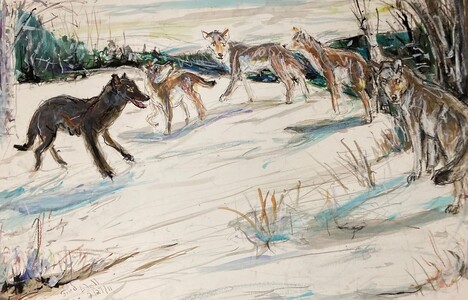
Wolves
2011
Mixed Media (Ink, watercolor, tempera) on illustration board
20" x 30"
2011
Mixed Media (Ink, watercolor, tempera) on illustration board
20" x 30"
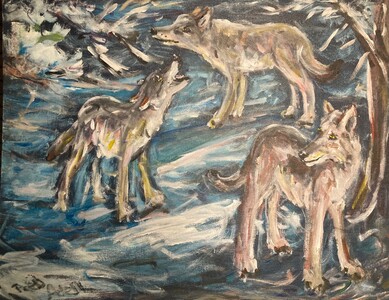
Wolves
2023
Acrylic on canvas panel
22" x 28"
2023
Acrylic on canvas panel
22" x 28"
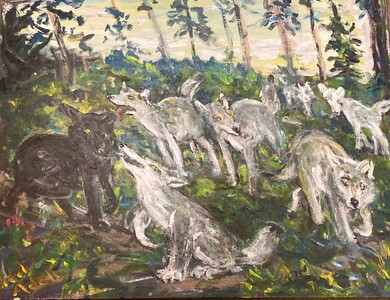
Wolves
1998
Acrylic on canvas panel
16" x 20"
1998
Acrylic on canvas panel
16" x 20"
" North American Red Fox (Vulpes fulva)")
"FOXY FAMILY (Vixen & kits)" North American Red Fox (Vulpes fulva)
2023
Acrylic on Canvas
16" x 20"
2023
Acrylic on Canvas
16" x 20"
9/9/23 @ the 40th Annual Queens County Fair's (Queens County Farm Museum) art exhibit.
" North American Red Fox (Vulpes fulva)")
Artist with "FOXY FAMILY (Vixen & kits)" North American Red Fox (Vulpes fulva)
2023
Acrylic on canvas
16"x 20"
2023
Acrylic on canvas
16"x 20"
9/9/23 @ the 40th Annual Queens County Fair's (Queens County Farm Museum) art exhibit.
")
"Leader of the Pack?" (self-portrait or paw-trait?)
2022
Mixed Media (Ink, watercolor, tempera) on illustration board
22" x 30"
2022
Mixed Media (Ink, watercolor, tempera) on illustration board
22" x 30"
Self-portrait with wolves
"")
"INTERIOR ALASKAN WOLVES (Canis lupus pambasileus )"
2021
Mixed Media(Ink, watercolor, tempera) on watercolor paper
18" x 24"
2021
Mixed Media(Ink, watercolor, tempera) on watercolor paper
18" x 24"
"")
"KENAI PENINSULA WOLVES (Canis lupus alces)"
2021
Mixed Media (Ink, watercolor, tempera) on watercolor paper
18" x 24"
2021
Mixed Media (Ink, watercolor, tempera) on watercolor paper
18" x 24"
"")
"CASCADE MOUNTAIN WOLVES(Canis lupus fuscus)"
2021
Mixed Media (Ink, watercolor, tempera) on watercolor paper
18" x 24"
2021
Mixed Media (Ink, watercolor, tempera) on watercolor paper
18" x 24"
"")
"NORTHERN ROCKY MOUNTAIN WOLVES (Canis lupus irremotus)"
2021
Mixed Media (Ink, watercolor, tempera) on watercolor paper
18" x 24"
2021
Mixed Media (Ink, watercolor, tempera) on watercolor paper
18" x 24"
 "")
"SOUTHERN ROCKY MOUNTAIN WOLVES (Canis lupus youngi) "
2021
Mixed Media (Ink, watercolor, tempera) on watercolor paper
18" x 24"
2021
Mixed Media (Ink, watercolor, tempera) on watercolor paper
18" x 24"
 FOX(Vulpes vulpes)"")
" SILVER (phase of Red) FOX(Vulpes vulpes)"
2021
White marker on black mat board
15" x 20"
2021
White marker on black mat board
15" x 20"
 aka 'LOBOS'"")
" MEXICAN GRAY WOLVES (Canis lupus baileyi) aka 'LOBOS'"
2020
Mixed Media ((Ink, watercolor, tempera) on watercolor paper
18" x 24"
2020
Mixed Media ((Ink, watercolor, tempera) on watercolor paper
18" x 24"
March 29 is part of "National Lobo Week ", 23 years ago today, some captive Mexican wolves were re-released into the wilds of the southwestern U.S. (Arizona & New Mexico) after being exterminated there for over 3 decades before.
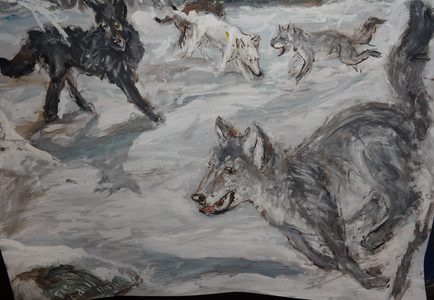
Wolves at My Door?...Timber Wolves -- (Canis lupus occidentalis)
2020
Mixed media (ink, watercolor, tempera) on watercolor paper
18" x 24"
2020
Mixed media (ink, watercolor, tempera) on watercolor paper
18" x 24"
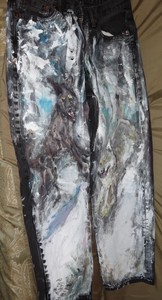
Wolves
2020
Acrylic on jeans
2020
Acrylic on jeans
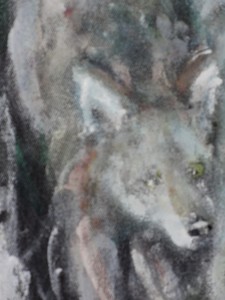
Wolf (detail)
2020
Acrylic on jeans
2020
Acrylic on jeans
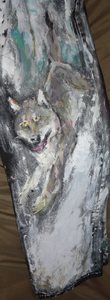
Wolf (detail)
2020
Acrylic on jeans
2020
Acrylic on jeans
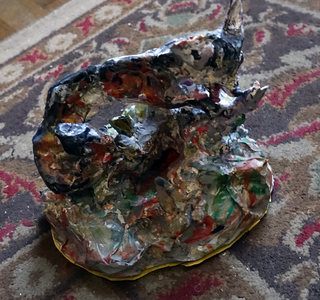
Gray Fox (Urocyon cinereoargenteus )
2019
sculpture (fired clay, paper mache, acrylic)
5" x 7" x 9
2019
sculpture (fired clay, paper mache, acrylic)
5" x 7" x 9
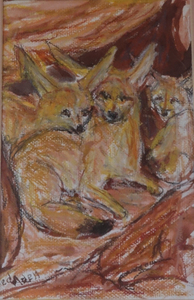
Fennec Foxes (Vulpes zerda)
2000
Mixed media (ink, watercolor, tempera) on watercolor paper
11" x 14"
2000
Mixed media (ink, watercolor, tempera) on watercolor paper
11" x 14"
")
"Denning Site" Eastern Timber Wolf (Canis lupus lycaon)
1994
Acrylic on masonite board
11" x 42"
1994
Acrylic on masonite board
11" x 42"
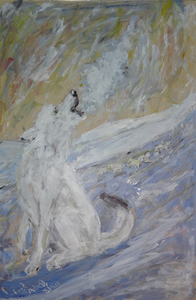
Arctic Wolf (Canils lupus arctos)
2019
Acrylic on glass
24" x 36"
2019
Acrylic on glass
24" x 36"
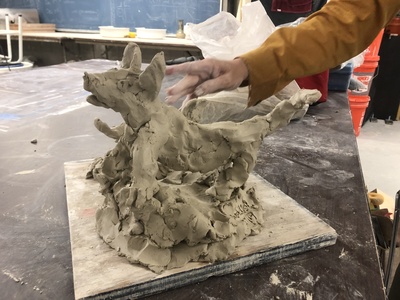
African Wild Dog (Lycaon pictus) and a Bat-eared Fox (Otoyon megalotis)
2019
clay
2019
clay
Images of the sculpture in process
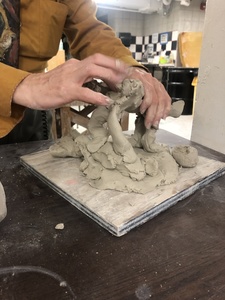
African Wild Dog (Lycaon pictus) and a Bat-eared Fox (Otoyon megalotis)
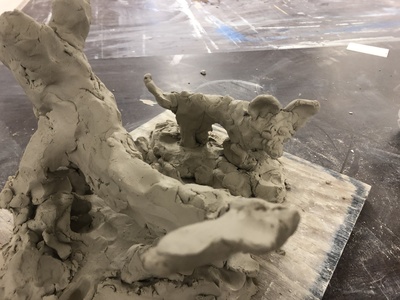
African Wild Dog (Lycaon pictus) and a Bat-eared Fox (Otoyon megalotis)
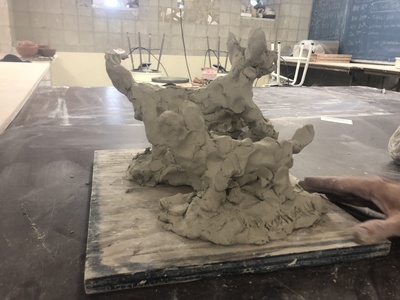
African Wild Dog (Lycaon pictus) and a Bat-eared Fox (Otoyon megalotis)
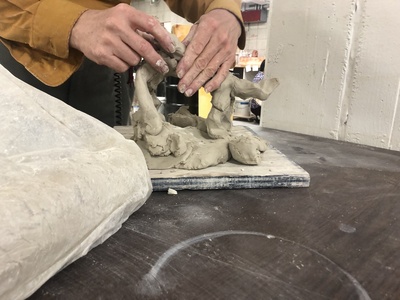
African Wild Dog (Lycaon pictus) and a Bat-eared Fox (Otoyon megalotis)
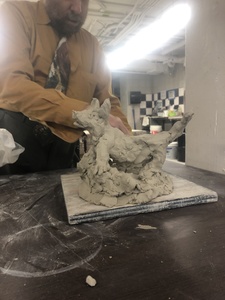
African Wild Dog (Lycaon pictus) and a Bat-eared Fox (Otoyon megalotis)
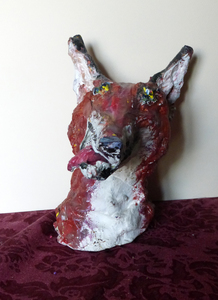
Crazy (Red) Fox Bust -- Vulpes fulva
1987
Mixed Media (Fired clay, paper-mache, acrylic paint)
4" x 5" x 8 "
1987
Mixed Media (Fired clay, paper-mache, acrylic paint)
4" x 5" x 8 "
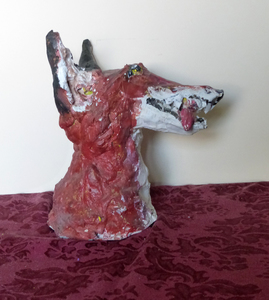
Crazy (Red) Fox Bust -- Vulpes fulva
1987
Mixed Media (Fired clay, paper-mache, acrylic paint)
4" x 5" x 8 "
1987
Mixed Media (Fired clay, paper-mache, acrylic paint)
4" x 5" x 8 "
side view
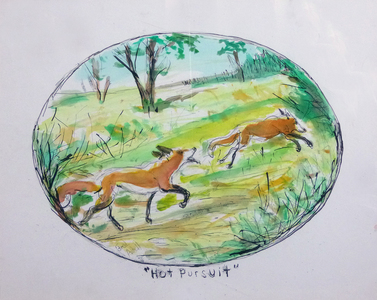
Hot Pursuit -- Red Foxes (Vulpes vulpes)
2013
Mixed media (ink, watercolor, tempera, oil pastel)
16 " x 20" (with 11" x 14" oval)
2013
Mixed media (ink, watercolor, tempera, oil pastel)
16 " x 20" (with 11" x 14" oval)
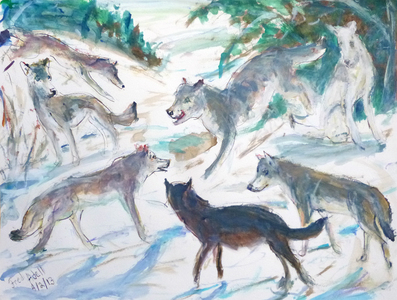
Winter (Timber) Wolves (Canis lupus)
2013
Mixed media (ink, watercolor, tempera, oil pastel)
18 " x 24"
2013
Mixed media (ink, watercolor, tempera, oil pastel)
18 " x 24"


